


7 Creative Ideas and Activities for Practicing Arrays

Amazing Arrays - a Great Way to introduce Multiplication!
Well, the secret is out - I love arrays! ❤️ Multiplicative thinking underpins SO much of elementary math. Connection with division, fractions, ratio, algebra and then high school math as well. And arrays are an excellent way to intoduce the concept to 1st grade and 2nd grade students.
What are arrays? It's the idea that the "x" in a multiplication problem refers to "rows of".
So if the problem is 3 x 5, you're asking students to consider "3 rows of 5" to model and solve the problem.

Why are arrays so powerful? While there are a few different strategies for teaching early multiplication (such as repeated addition and making equal groups), I find arrays have the most impact for early leaners as they are very visual and are much easier to scan, count or read than groups or repeated addition. In fact, Booker suggests this strategy is of the greatest importance, ahead of equal groups and repeated addition and links best to division (Booker et al, 2014).
So if you're introducing the concept of multiplication to 1st grade or 2nd grade students, it's worth spending a few lessons on arrays. As always, start with a little explicit teaching and then consider some of these ideas for independent work.
4 Hands On Arrays Activities for Math Centers
The grid-like concept of arrays lends itself nicely to LOTS of fun hands-on activities! Here are a few of my favorites 😊
Arranging Pom poms, Play-doh, Stickers, Counters or other objects
Look, you can make an array using anything really. Pebbles, pom-poms, mini erasers, counters, M&Ms.. anything! The trick of course is to not get TOO creative as the items might disappear (honestly, does anyone actually use M&Ms or it that something we just see on Pinterest?) I do sometimes like to have students create little balls from play-doh, but that can get distracting too. Pom poms, stickers or counters work great.
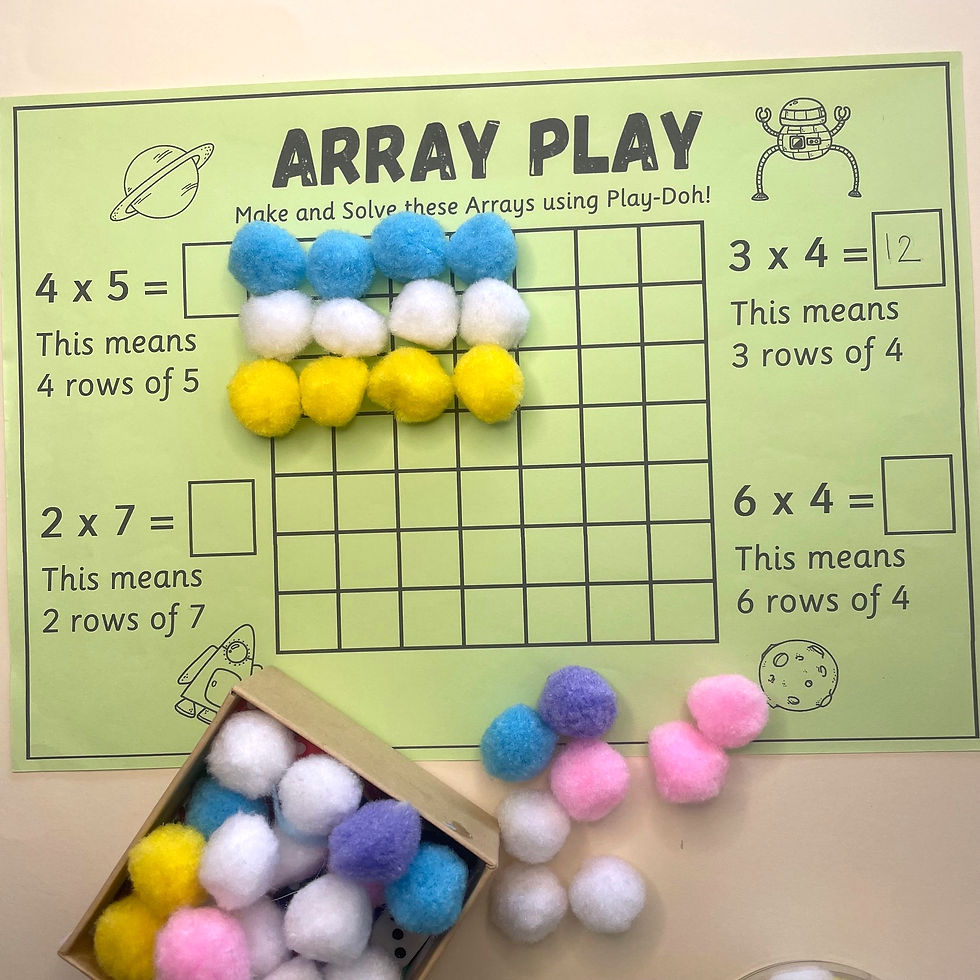 |  |
To get them going, students can roll dice to create a multiplication problem, grab a task card or you can write problems on the whiteboard.... and then its simply a matter of students arranging the items and calculating the answer (ideally by skip counting)... easy!
Stamping Boxes
I've used this a few times in the classroom and the kids LOVE it. If you've got a tub of simple stamps on hand (usually easy to find in the dollar store or wherever you find kids party favors) it's super easy to set up. You can just provide grid paper or you can use a pre-set mat like the ones in my resource below.
 |  |
Plastic Bricks or LEGO
Another favorite with the kids and easy to set up. Just provide a central tub of plastic bricks in a variety of shapes (either for small group work, or place smaller bowls on tables etc) and students can count the 'studs' and draw and analyse each block or brick as an array.

Pop Boards
Another fun one for the kids, but does require some specialist equipment - you'll need to source some good size "pop" boards to run your station. These below are only 6x6 but you can definitely get larger ones like 10x10. Kids pop the rows of bubbles as need to create their array and solve the problem.

3 Colorful Array Crafts that make great Bulletin Boards!
I do think arrays really lend themselves to some great activities - AND in the same way you can also make some great crafts and displays! These print-and-go arrays coloring pages have even less prep and pack up and make great bulletin board displays. I particularly like to use them as an end-of-unit consolidation activity. All 3 of these arrays resources below are from my own TPT store and are some of my best sellers!
Simple Arrays City
Back when I first started teaching, an arrays city activity meant that kids were pasting little yellow squares onto a black or colored building. Yes, great for fine motor skills but SO fiddly and messy as a math craft! So I created my own templates and printables so students could color in the boxes instead 😊 Once completed you can line them along your walls and make one long cityscape. And this one even has a bit of a super hero theme.
You can grab the printables by clicking on the button below.

Up, up and Array! Hot Air Balloons
This craft makes a GREAT multiplication bulletin board display because it's a mix of hot air balloons, houses, clouds and more. Students choose a multiplication problem and then color in the squares in patterns or rows to decorate the balloons. Then cut out and arrange on your bulletin board! Click on either image below if you want to take a closer look 👀
 |  |
Arrays Christmas village
So this one is seasonal and great for the lead up to Christmas or the holiday break. Similar to the above two, students create a multiplication problem and then color rows to solve. This one is great to color in, cut out and make a seasonal bulletin board display. I even like to add green trees cut from colored paper and other extras - it looks amazing and festive and kids LOVE seeing their work on display.
 |  |
So Where to Next after Teaching Arrays?
Most educators would agree that it's important to expose students to a range of different strategies when teaching a math topic. Some little minds just work differently and although I love arrays, they may find equal groups or repeated addition just makes more sense for them. So I'd definitely still cover these strategies too - and then also cover off on the commutative property of multiplication - that is, the ideas that 6x4 is the same as 4x6.
And then before you know it, your second grade students will be ready to move on to multiplication fact recall (I'd start with 2s, 5s and 10s!) and beyond. And that's a WHOLE other world ☺️ - and definitely a separate blog post!


.png)


